How AI regulation is delayed
Twelve patterns used to delay the regulation of artificial intelligence.
When AI regulation is debated, the arguments against it are remarkably stable, whoever makes them, in whatever forum and about whatever specific proposal. The Excuses Compass documents twelve of these recurring patterns, which serve, alone or in combination, to delay regulatory action, to delegitimise it or to block it structurally.
The four axes
Some patterns push responsibility onto others, some play down the need to act, others end in resignation before the technological, and a fourth group construes regulation itself as the source of harm.
FIG. 1 · WHATABOUTERY 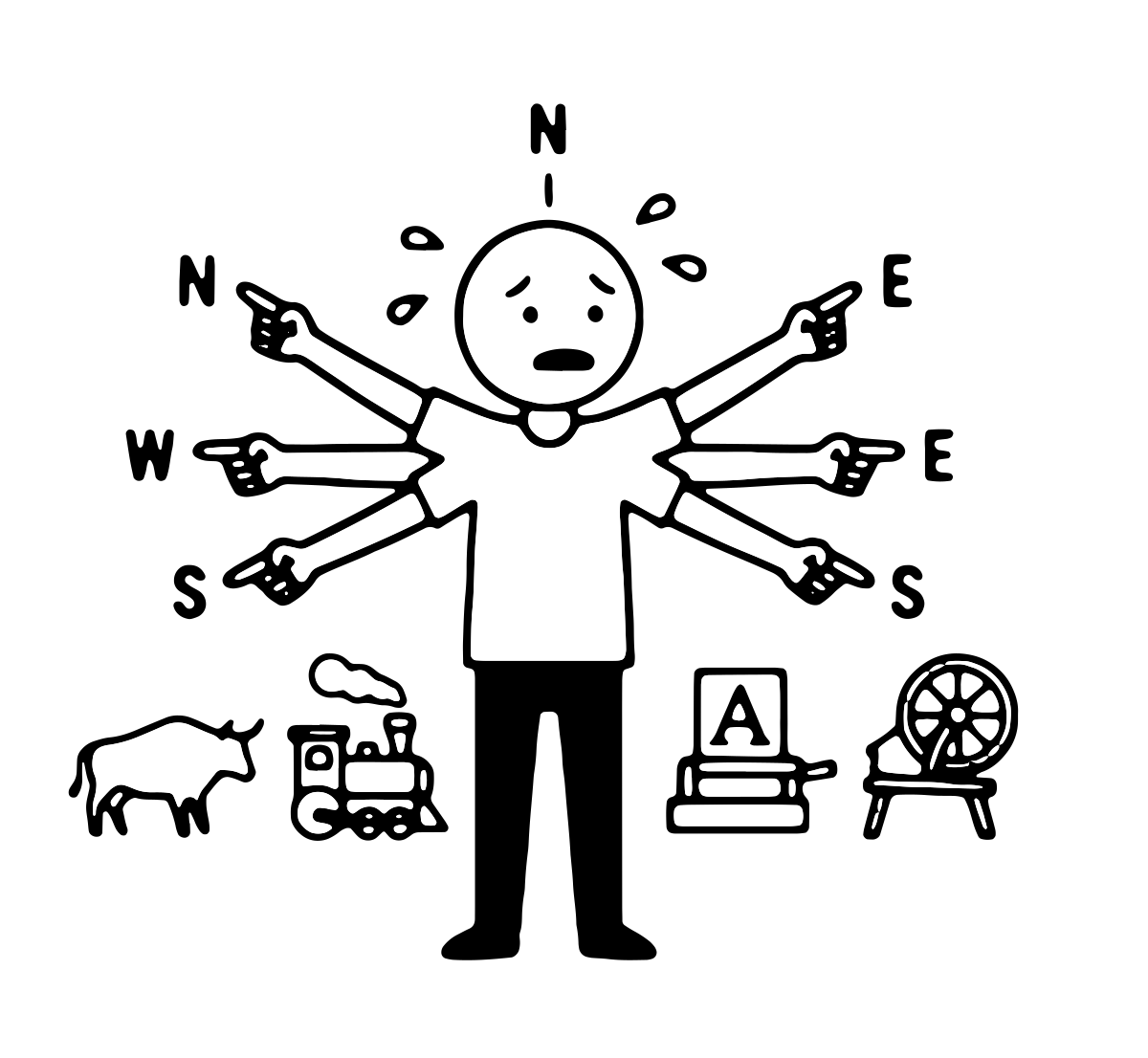 The Deflector “Haven't we always had algorithms? The wheel. The steam engine. Same thing.”
Historical analogies blur the qualitative difference between earlier technologies and AI systems that act on millions of people in real time.
Whataboutery in the AI debate is a rhetorical technique in which concerns about artificial intelligence are answered by pointing to historical precursors. “Didn't we have the same debates when printing was introduced?” or “The wheel wasn't regulated either”. At first hearing these sentences sound reasonable. They are not.
The structural problem lies in confusing quantitative with qualitative discontinuity. Every technology brings change, but not every technology alters the epistemic, social and economic foundations of a society at a comparable breadth and speed. Language-generating AI systems that can produce millions of texts in fractions of a second, texts people do not recognise as machine-made, are not comparable in their social effect to weaving, even though both are “new tools”.
Whataboutery also carries an implicit message: since earlier societies “survived” technological transformations, this generation will too, and without regulatory intervention. That conclusion ignores the fact that earlier societies by no means navigated technological change unharmed. Industrialisation produced decades of child labour, mass impoverishment and political violence before regulatory intervention began to contain the worst excesses.
In the AI debate, whataboutery serves primarily to slow governance down: opening every regulatory discussion with historical parallels shifts the focus from concrete risk potential to abstract questions of continuity, and buys time.
- · Discourses of climate delay · Global Sustainability
- · Do Artifacts Have Politics? · Daedalus
- · Dreamscapes of Modernity · Univ. of Chicago Press
FIG. 2 · INDIVIDUALISM 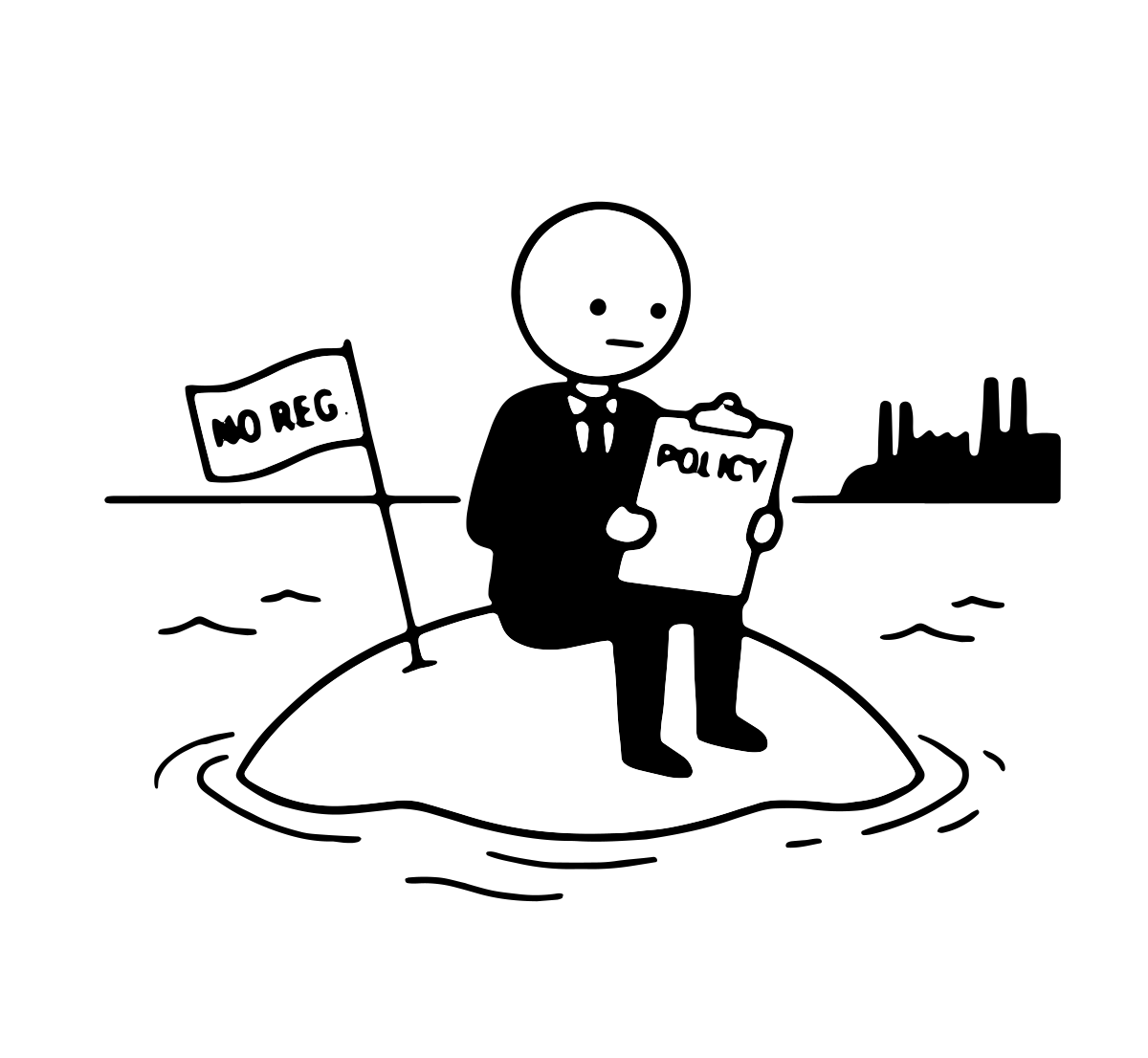 The Single Cell “Regulation is paternalistic. Everyone decides for themselves whether AI is used ethically.”
If everyone decides for themselves what is ethical, then in practice those with the most servers decide.
The individualist reflex in the AI debate translates a systemic risk problem into a question of personal responsibility. “Every user can decide for themselves how they use AI.” It sounds like freedom; structurally it is an imposition.
The error lies in assuming that harm from AI systems arises mainly from individual decisions about use. In fact the relevant risks, algorithmic discrimination in lending or recruitment, automated disinformation in the political sphere, data protection breaches through opaque training processes, are not the consequence of individual bad choices but properties of systems that a single user can neither influence nor survey.
Someone refused credit because a model weights their postcode as a risk feature has not made a “bad decision”. An applicant who scores worse in an automated screening system because the training corpus reproduces historical pay inequality has not made a choice she could have corrected by behaving more cleverly.
Locating responsibility at the level of the individual is therefore not only analytically wrong; it has a political function. It relieves system developers and platform operators of structural accountability. The term “digital maturity”, which turns up regularly in this context, then denotes not empowerment but relief for the producer side.
Systemic risks cannot be regulated through individuals taking responsibility. That would presuppose access, information and power that individuals structurally do not have.
- · Privacy Self-Management and the Consent Dilemma · Harvard Law Review
- · Das Zeitalter des Überwachungskapitalismus · Campus Verlag
- · Big Data's End Run around Anonymity and Consent · Cambridge University Press
FIG. 3 · FREE-RIDER EXCUSE  The Geopolitician “China and the US are developing it anyway. We change nothing and only fall behind.”
The argument that other states will not regulate creates a collective action problem which is then used to justify inaction, although it would in fact call for acting together.
The geopolitical argument is the free-rider problem in its purest form: because other actors (usually China or “Silicon Valley”) develop without regulatory constraints, regulating at home appears not merely ineffective but self-harming. Regulation is framed as unilateral disarmament in a technology race.
The error can be taken apart on several levels. First, the empirical premise is false. The European Union with the AI Act, individual US states, and increasingly Chinese authorities as well, have developed or announced regulatory frameworks. The “unregulated wild west” is a framing, not a description of the actual global governance landscape.
Second, the argument confuses competitiveness with recklessness. There is considerable evidence that regulatory frameworks, particularly binding quality and transparency standards, build long-term trust in technologies and thereby ease market adoption rather than obstruct it. The GDPR shows that European data protection standards established themselves as a model exported worldwide, not as a competitive disadvantage.
Third, the argument carries a troubling logic. If every actor points to the behaviour of others to justify their own passivity, the result is collective under-regulation as a structural equilibrium, a classic incentive problem of collective action that cannot be solved by pointing at others but only through coordinated governance.
- · Artificial Intelligence Policy: A Primer and Roadmap · UC Davis Law Review
- · The Chinese approach to artificial intelligence · AI & Society
- · Chinese AI in a Global Context · CNAS
FIG. 4 · ETHICS THEATRE  The Smokescreen “We are a world leader in responsible AI. Ethics committee appointed. Done.”
An ethics board that takes no binding decisions is decoration, not governance.
“Responsible AI”, “Ethical AI by Design”, “AI Safety Teams”: the inflationary use of these terms in the self-presentation of large technology companies is as remarkable as the simultaneous absence of binding mechanisms that would give the promises substance. Research has described the phenomenon as “ethics washing”: symbolic compliance without structural consequence.
The pattern is consistent. A company announces an ethics board. The board meets and publishes principles. The principles are formulated as aspirations, not as binding requirements. They contain no sanctions, no independent review, no escalation paths. The board is dissolved or restructured when its recommendations become inconvenient for product policy, which happens regularly.
The language of these initiatives is especially telling. “We believe AI should be safe, fair and transparent” is not a governance statement. It is an opinion. The decisive question, “and what happens when your systems are not?”, remains structurally unanswered in corporate ethics papers.
Ethics theatre has an important political function: it occupies the space that binding regulation would fill, with soft signals, and thereby communicates to regulators “we are handling this ourselves”. That such self-regulation systematically fails in structurally under-regulated markets is no surprise but a predictable consequence of missing enforcement.
- · From Ethics Washing to Ethics Bashing · ACM FAccT
- · The global landscape of AI ethics guidelines · Nature Machine Intelligence
- · Owning Ethics · Social Research
FIG. 12 · TECHNO-FATALISM  The Unfazed “AI is as unstoppable as gravity. Surf it or be rolled over.”
Presenting technological change as a law of nature strips political decisions about direction, pace and distribution of their legitimacy.
Technological determinism is the conviction that technology develops along a path of its own, largely independent of social decisions. In its more drastic form, techno-fatalism, the conviction implies that societies adapt to technologies rather than the other way round. In the AI context the statement runs: “AI will prevail whether we like it or not. The only question is whether we are at the front or the back.”
The empirical evidence for strong technological determinism is weak. Social decisions about research funding, patent law, infrastructure investment, labour market policy and regulatory frameworks shape considerably which technologies develop, how fast and in which direction. The internet would have different properties without state research funding. Nuclear technology developed differently in different social contexts. The assumption that AI is a natural phenomenon unfolding independently of human decisions is a political statement dressed as a scientific description.
The surfing metaphor is particularly powerful. It makes adaptation the rational response to an unavoidable wave and thereby pathologises attempts at regulatory steering as irrational resistance to the inevitable. The metaphor transfers a physical property, waves cannot be stopped, onto a sociotechnical system that is in fact shaped to a considerable degree by institutional and political decisions.
The social appeal of fatalism lies in the relief it offers. If change is unavoidable, the uncomfortable question of responsibility, design and democratic legitimacy for decisions with far-reaching social consequences falls away. Governance work is laborious; surfing sounds easier.
- · The Social Shaping of Technology · Open University Press
- · Autonomous Technology · MIT Press
- · The Ethics of Invention · W.W. Norton
FIG. 11 · APOCALYPTICISM  The Doom-Sayer “AGI makes everything irrelevant. Regulating is window-dressing before the inevitable.”
The idea of an inevitable AI superintelligence makes present governance work meaningless, with the same result as technological optimism: standstill.
The apocalyptic and the technosolutionist AI discourses look like opposites, one seeing AI as a threat to humanity, the other as its salvation. Structurally they are siblings. Both present future AI capacities as so overwhelming that present governance appears meaningless. Their emotional content differs; their political consequence is nearly identical.
The apocalyptic variant typically works with superintelligence or a “singularity”: a point at which AI systems irreversibly exceed human control. If that point is coming anyway, the implication runs, all attempts at regulation are cosmetics at the edge of the abyss. The figure appears both among serious AI safety researchers and among media-friendly AI enthusiasts, and both tend to be sceptical of the concrete political work on regulatory frameworks.
The problem is not that existential risks from AI should be taken less seriously; they should be taken seriously. The problem is the conclusion drawn from that seriousness. When the answer to “AI could be catastrophic” is “so we had better not regulate”, a short circuit has occurred. The obvious conclusion is the opposite: precisely because the risks are potentially severe, robust governance is needed.
It is also worth noting who places apocalyptic narratives in the debate. Often they are actors simultaneously and intensively involved in developing powerful AI systems. The message “it is coming anyway, and it will be enormous” has a double effect: it produces public awe and at the same time delegitimises regulatory intervention as inadequate or counterproductive.
- · Superintelligence · Oxford University Press
- · Rebooting AI · Pantheon
- · AI4People, An Ethical Framework · Minds and Machines
FIG. 5 · TECHNOSOLUTIONISM  The Messiah “AGI will solve climate change, hunger, poverty. We must not slow development down!”
Expecting future AI solutions to social problems suspends the need for present regulation indefinitely.
The technosolutionist position is one of the oldest in the philosophy of technology: technology itself is cast as deliverance from the problems it may have helped cause or will help cause. In the AI context the figure takes particularly elaborate forms. Artificial general intelligence is positioned as the future solver of present social challenges, and that positioning serves at the same time as an argument against present regulation.
The argumentative structure is a kind of temporal arbitrage: future capacities are set against present regulatory costs. “If we slow development now, we lose the chance to save the climate later.” The statement is problematic in several ways. It assumes the realisation of future capacities as given. It ignores that today's AI systems already cause considerable emissions through training. And it conceals that regulation rarely aims at prevention, but at steering.
The selectivity of technosolutionism is especially telling: the solving of future problems by AGI is treated as certain, while the risks of future uncontrolled AI systems are dismissed as speculative. This asymmetric treatment of uncertainty is not an epistemic mistake but a rhetorical strategy.
In discourse analysis it stands out that technosolutionist arguments are frequently made by those whose economic interests depend on accelerated development, which raises the question of how to separate epistemic conviction from interest-led communication.
- · To Save Everything, Click Here · PublicAffairs
- · Artificial Unintelligence · MIT Press
- · AI Ethics · MIT Press
FIG. 6 · SCALING FETISH  The Scaler “Once the models are big enough, all the problems solve themselves.”
More parameters are supposed to solve the problem that more parameters created. Gains from scaling are presented as a solution, although many of the relevant risks only arise through scaling.
The scaling hypothesis, the assumption that larger models with more data and more compute produce qualitatively better and safer systems, has become one of the most powerful and at the same time most problematic articles of faith in the AI debate. Its evidence base is mixed; its political function is clear.
Empirically it is true that scaling has produced measurable performance gains in certain task domains, particularly in language benchmarks. What those benchmarks test, and whether they are valid for socially relevant dimensions of quality, is a separate question. Scaling does not necessarily improve a model's calibration, the match between stated uncertainty and actual error rate. It does not systematically reduce hallucination. And it does not solve the underlying alignment problem, the question of whether systems do what users actually want.
The political function of the scaling faith lies in its implication for regulation: if “more data and more compute” solve the problems by themselves, external governance is unnecessary. Regulation is framed as interference in a self-correcting process. That this process has historically produced no consistent evidence of self-correction in safety-relevant dimensions barely troubles the narrative.
The ecological dimension, systematically left out of the scaling debate, is also notable. Training very large models consumes considerable amounts of energy and water. “More compute” is not a neutral technical statement but a decision about resources with global consequences.
- · On the Dangers of Stochastic Parrots · ACM FAccT
- · Atlas of AI · Yale University Press
- · Energy and Policy Considerations for Deep Learning in NLP · ACL Anthology
FIG. 10 · SCAREMONGERING 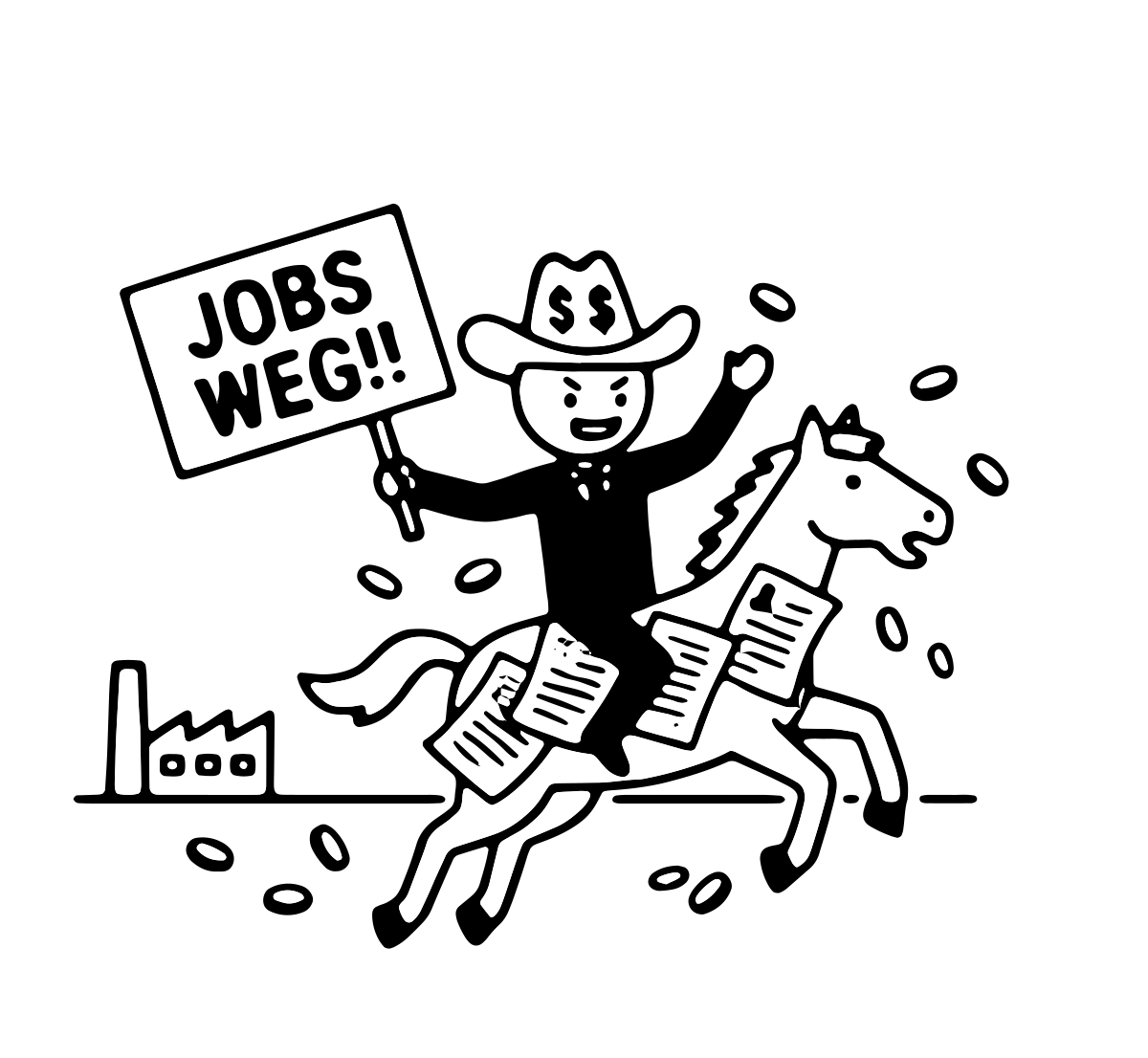 The Job Cowboy “Regulation costs thousands of jobs! We are destroying our competitiveness!”
The cost of regulating is quantified precisely, while the economic consequences of not regulating stay invisible as external costs.
Economic impact assessments are a legitimate and necessary part of regulatory debate. What economic costs and benefits a measure produces deserves careful empirical analysis. The pattern described here is a different one: the selective, asymmetric use of economic argument to delegitimise regulation.
The asymmetry usually shows in the fact that regulatory costs are named precisely, compliance effort, potential slowing of development cycles, hypothetical competitive disadvantage, while the economic cost of not regulating stays invisible. What does it cost when AI-based credit scoring discriminates? What does it cost an economy when disinformation systems erode trust in democratic institutions? What do the employment effects of unregulated automation cost when no retraining accompanies them?
These questions disappear from the cost debate systematically, because answering them is methodologically harder and because those affected are less well organised than the companies being regulated. Economists speak of negative externalities: costs borne by third parties and therefore absent from private calculation, unless regulation forces them to be internalised.
The comparison with other regulated fields is instructive. Food safety standards “cost” the food industry money. Emissions rules “cost” carmakers money. The question is not whether regulation produces costs, it always does, but whether those costs stand in proportion to the harm avoided. Scaremongering consistently declines to ask that question.
- · Automation and New Tasks · Journal of Economic Perspectives
- · The Risk of Automation for Jobs in OECD Countries · OECD Working Paper
- · Automating Inequality · St. Martin's Press
FIG. 9 · NIRVANA FALLACY  The Perfectionist “Only a solution that fully satisfies ALL stakeholders can be considered.”
Demanding regulation that everyone can agree to is structurally impossible in a pluralist society and therefore works as a permanent veto.
The nirvana fallacy is a classic argumentative pattern: a real, imperfect solution is measured not against other real, imperfect alternatives but against an ideal state that is unreachable by definition. In AI regulation the corresponding statement reads: “We should only introduce regulation that is fully supported by all relevant stakeholders.”
In complex policy fields with heterogeneous interests, and AI governance is one, there is no state of universal agreement. Regulatory measures affect different actors to different degrees and regularly produce losers as well as winners. The requirement of full consensus is therefore not a demanding standard but a structural veto for every single actor with a conflict of interest.
Democratic societies have developed solutions for this problem: majority decisions, procedures for compromise, legally structured balancing of interests. These mechanisms produce decisions that are not perfect but legitimate and revisable. Demanding consensus is therefore no strengthening of democracy but its circumvention through blockade.
Perfectionism is especially powerful in combination with time pressure. While the ideal regulatory framework is being negotiated, systems can be rolled out that might not have been approved under a hypothetically better regime. Time is not neutral here: every delay in the regulatory process is at the same time a permission for continued unregulated deployment.
- · The Social Control of Technology · Frances Pinter
- · Understanding Regulation · Oxford University Press
- · Algorithmic governance: Developing a research agenda · Big Data & Society
FIG. 8 · INSTRUMENTALISATION  The False Knight “Regulation hurts the Global South most of all! Think of the poorest!”
Social justice as a pretext. Legitimate questions of justice are turned against protective measures without any alternative protection being proposed for the groups invoked.
Questions of justice in the AI context are necessary and warranted. AI systems reproduce and amplify existing inequalities, through skewed training data, through unequal access, through the geographic concentration of AI value creation in the Global North. These problems are real and demand structural answers.
The pattern described here is a different one: the instrumentalisation of legitimate justice discourse as a rhetorical device against any form of AI regulation, without any alternative protection being proposed. “Regulation harms the Global South” appears frequently in debates about regulatory measures, never underpinned by a concrete analysis of why protection standards, of all things, would disadvantage marginalised groups.
The empirical evidence points the other way. AI systems without quality standards and accountability harm disproportionately those with little political and legal access to enforcing their interests. Unregulated automated decision systems in asylum procedures, in social transfers or in lending systematically disadvantage vulnerable groups.
The dishonesty of this figure lies not in its words but in what it leaves out. Whoever deploys justice discourse against regulation without naming alternative protection is using marginalisation as a shield for something else. The question cui bono, who benefits from this argument, is particularly worth asking here.
- · Decolonial AI · Philosophy & Technology
- · Algorithmic injustice: a relational ethics approach · Patterns
- · Data Colonialism · Television & New Media
FIG. 7 · SOFT LAW ONLY  The Non-Committal “Binding regulation kills innovation. An honest industry commitment is enough.”
Voluntary commitments without external review leave the definition of compliance to those whose behaviour is meant to be regulated.
The argument for voluntary commitment as a substitute for binding regulation is at heart a theory of governance: industry knows its technologies better than public authorities, has a self-interest in safe operation through reputational risk, and can react faster than democratic legislation. All three premises are at least open to question.
The information gap between industry and regulator is real, but it is not an argument against regulation; it is an argument for better regulatory capacity and transparency obligations. Reputational risk disciplines companies in visible consumer markets; in business-to-business AI, in decision-support systems for public bodies, or in algorithmic systems whose effects are diffuse and delayed, the disciplining mechanism is considerably weaker. And speed of reaction is no value in itself: acting fast without binding force merely produces non-binding commitments at a higher frequency.
Evidence from other sectors, financial market regulation, environmental protection, food safety, shows that voluntary commitment as the sole mode of regulation fails systematically in areas with incentives to externalise. Where the cost of harm can be shifted onto third parties, there is no sufficient market incentive for sufficient protection.
What soft law can contribute within a hybrid governance architecture, flexibility, sector-specific expertise, quick adaptation to technological change, is genuinely valuable. Demanding soft law as the exclusive instrument, however, delegitimises binding governance without empirical grounds. A pinky promise with oneself is no substitute for a contract with society.
- · AI Governance: A Research Agenda · Future of Humanity Institute
- · Standards for AI Governance · Future of Humanity Institute
- · Blackbox Algorithmus · Springer VS
Related
Let us talk about what you have in mind.
A first conversation costs you half an hour.